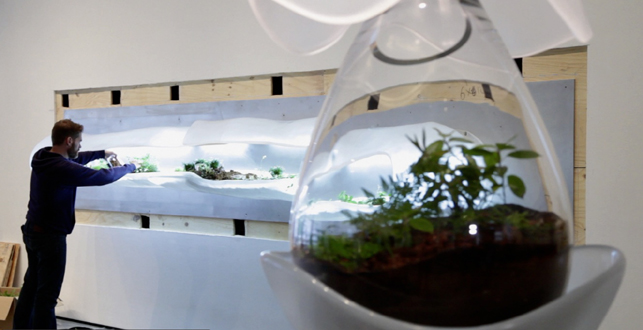
Paula Hayes's assistant, John Gray, installs the plantings for the installation Nocturne of the Limax maximus
When Hermes and Aphrodite had a son, Hermaphroditus, who was fused with a nymph, Salmacis, the resulting person possessed the physical traits of both male and female—hence the term “hermaphrodite,” used in biology as a description of similarly dual reproductive traits in both plants and animals. Applied to humans, the term is considered derogatory—as the term “hermaphrodite” developed, in the Victorian age, a dehumanizing fetishistic/pornographic/freak-show connotation—and is now preferably replaced by “intersex.”
The Limax maxumus—the Leopard slug referred to in the title of my commissioned installationsimultaneous hermaphrodite” that is not capable of self-fertilization. It takes two to tango: with each being fertilized by the other via male anatomical delivery systems that protrude from the sides of their heads, dispensing sperm into one another’s internal ovaries during an unusually sensual and beautiful mating process. on view in MoMA’s lobby—is a “
So, the possession of both female and male “parts” occurs in many manifestations in both plants and animals with many nuances, characteristics, and abilities. What separates this physical classification of gender in humans is the pressure to conform to a binary gender system when other human dimensions come into play in the continuum of gender identification. Most specifically the spiritual, psychological, and emotional realms.

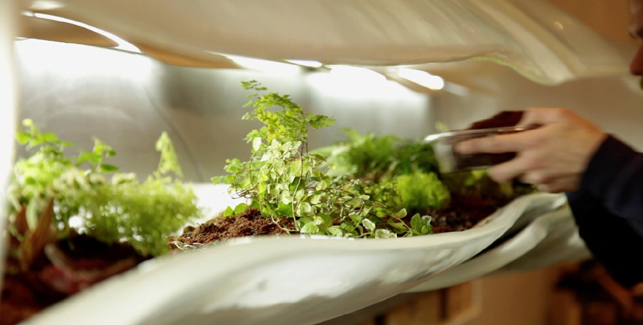
Close-up view of plantings for Paula Hayes's installation Nocturne of the Limax maximus
In a giant leap, I will go as far to say that our own particular nuances of gender, which are repressed by the pressure to uphold a binary system, seep into infinite areas of cultural expression. The areas that fascinate me most are the comparisons of female roles in not only art as an object, but in the practice of art making itself. The female’s status as a subject, through possibly marriage or genetic lineage (in portraiture), and divisive fetishistic roles since the beginning of human art production, potentially distracts us from a cultural feeling of the feminine forces of gestation, birth, and nurturing as not only subjects in art, but in the actual performance of art making and the literal transference to future generations in living art forms, forms that require varying degrees of participation to enact the intention of the work versus the conservation of a period of time known as the “time of execution.” Living art literally involves the attentive and continuous role of participants and caretakers in all aspects of the continuum of its manifestation and life; this reality is at its core—a core that is performed by humans along any point in the spectrum of gender. It is essential that there be an internal, collaborative maintenance of the life of the work so that it can exist as an artwork. Binary systems (such as owner/object) become irrelevant, while interrelatedness and continuously active and attentive devotion become essential.
November 30, 2010 - from the MoMA website